The ADHD Visual Clutter Tax: Why Messy Spaces Make Starting Harder
Sometimes the problem is not laziness, discipline, or motivation.
Sometimes your eyes are doing too much work before your brain even gets started.
Recent ADHD coverage keeps landing on the same point from different angles: visual distraction, open tabs, notifications, and repeated task switching quietly drain attention. A February 2026 Psychology Today workplace piece and a March 2026 ADD Resource Center article on ADHD overwhelm both reinforced that when everything feels equally loud, the brain struggles to rank what matters.
That is the visual clutter tax.
It is the extra mental cost of seeing too many loose ends at once. For ADHD brains, that cost is real.
What visual clutter actually does
Visual clutter is not just a messy room.
It is a pile of objects, tabs, notes, chargers, papers, unopened mail, half-finished tasks, and random reminders all competing for attention at the same time.
Every visible item is a tiny decision.
- Should I deal with that?
- Did I forget something there?
- Is that urgent?
- Am I behind again?
You may sit down to answer one email and your brain gets dragged into six other unfinished loops before you even click.
That is why clutter often feels bigger than clutter. It feels like pressure.
The goal is not minimalism
You do not need a perfect desk. You do not need a Pinterest office. You need a workspace that asks less from your brain.
That means reducing what is visible, not because tidy is morally better, but because fewer inputs make starting easier.
A clean enough space is not about looking impressive. It is about lowering the number of decisions between you and the first useful move.
Try this ADHD-friendly reset
1) Create one launch pad
Pick one small area where today starts: the center of your desk, one notebook, one browser window, or one section of the kitchen counter.
This is your launch pad. Only the current task gets to live there. Not the whole day. Not your whole life. Just the thing you are starting now.
2) Make one parking bin
A lot of clutter exists because your brain does not trust hidden systems. So do not force yourself into a perfect filing system.
Use one visible but contained parking spot for loose items: one tray, one basket, one tote, or one digital note called Later.
The rule is simple: if it is not part of the task you are doing right now, it goes in the parking spot. Not forever. Just for now.
This matters because “get it out of sight” is often more useful than “fully organize everything.”
3) Protect two surfaces
If you have ADHD, protecting every surface is usually too hard to maintain. Protect two only: your main work surface and your today list.
That is enough. If those two stay clear, you can usually recover faster even when the rest of life is a little chaotic.
4) Cut digital clutter too
Physical clutter is only half the story. Digital clutter is sneaky because it feels productive.
Open tabs, desktop icons, unread notifications, and five different task apps create the same mental drag.
- Close tabs you are not using now.
- Mute non-essential notifications for one work block.
- Keep one task list open, not three.
- Put your phone out of reach for 20 minutes.
If your digital setup is part of the chaos, take the ClarityBolt quiz and see where your biggest friction point actually is: ClarityBolt quiz
Use the 10-minute rule
Do not tell yourself you are going to clean the whole room. That is how people freeze.
Tell yourself this instead: for 10 minutes, I am only reducing visual noise. Not organizing perfectly. Not solving every pile. Just reducing what my brain has to look at.
A good 10-minute reset might look like this:
- Throw away obvious trash.
- Stack loose papers into one pile.
- Move random objects into the parking bin.
- Clear the center of the desk.
- Leave only the tools for the next task.
That is enough to change the feel of the room. And when the feel changes, starting usually gets easier.
If you want extra structure
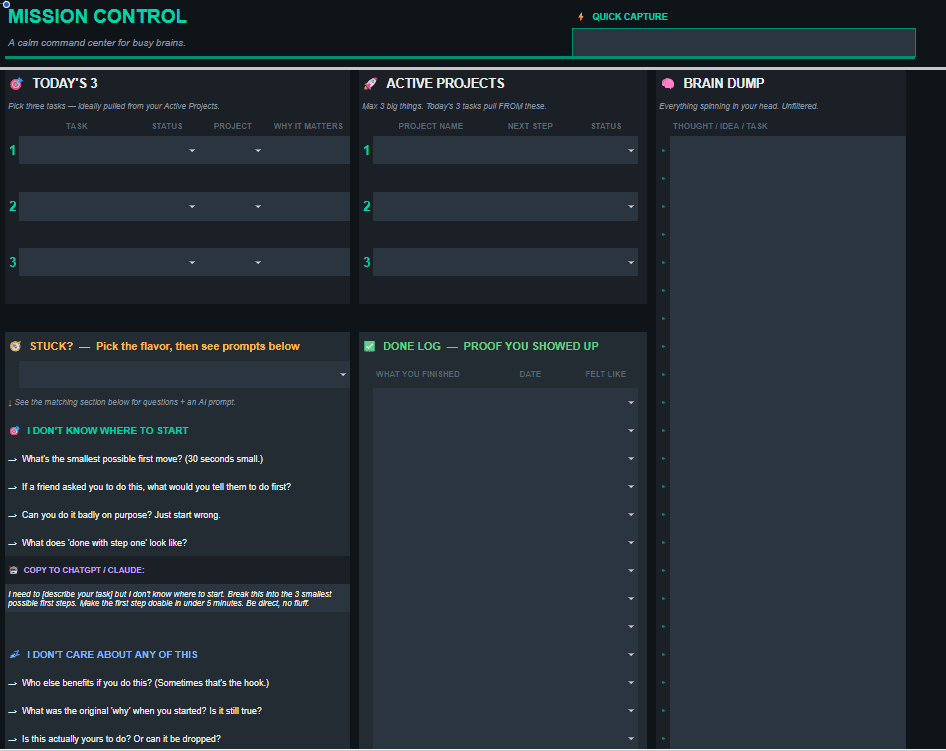
If the problem is not just clutter but also having too many scattered lists, sticky notes, and open loops, use one clear command center instead of five half-systems.
That is exactly what Mission Control is built for: one dark-mode daily dashboard that gives your tasks a home without turning planning into another project.
You can see it here: Mission Control on Etsy
Final thought
If starting feels weirdly heavy, do not just ask, “What is wrong with me?”
Ask, “What is in my field of view?”
For a lot of ADHD brains, progress starts when the environment stops yelling. Make the next move easier to see. Then make only that move.
try the tool
Ready to try Mission Control?
A calm daily dashboard for Excel and Google Sheets. $24.99.